


How Does Low Code Development Work
A Guide to Principles and Best Practices for Low Code Development
Key Capabilities for Enterprise Low Code Applications Platform
Enhancing Development Efficiency: Integrating SDLC, CI/CD, and DevOps
Comprehensive Security and Compliance Features
What are low-code use cases and examples?
In the face of intense global market competition, companies must navigate complex decisions, leveraging every possible advantage to ascend to or maintain their market position. Among these advantages, the role of innovative, cutting-edge software cannot be overstated.
The crucial challenge lies in acquiring such software both swiftly and cost-effectively. Low-code platforms have emerged as a compelling solution to this challenge, increasingly gaining popularity for their ability to democratize software development and accelerate digital transformation.
This article explores how low-code concepts and practices can help enterprise developers be more efficient, create valuable apps quickly, and contribute to broader business initiatives.
How Does Low Code Development Work
Traditional software development is a meticulous and intensive process where developers craft each line of code to construct the intricate architecture of applications. This classical method requires a comprehensive understanding of various programming languages and development environments (including integrated development environments and compilers) alongside testing and deployment methodologies. Moreover, developers must navigate through the complexities of coding standards, testing frameworks, and deployment strategies to bring software from conception to deployment.
Low-code platforms introduce an innovative abstraction layer that simplifies the software development process. A simple idea of low code development where software is built using preexisting elements like building blocks. Instead of writing code line by line, users interact with a graphical interface that allows them to select, drag, and drop pre-built functional components. These components, akin to the pieces of a puzzle, can be assembled to construct the application's logic and workflow in a manner that resembles structuring a flow chart to solve a business problem.
This visual and intuitive method of application construction empowers users to modify the software structure easily by adding, rearranging, or removing components as needed. Upon finalizing the design, the low-code platform automatically generates the requisite underlying code, seamlessly integrating essential support tasks such as testing and deployment into the development lifecycle.
Through this transformative approach, low-code platforms democratize application development, making it accessible to a broader audience beyond traditional programmers.
By abstracting the complexity of coding and automating the ancillary processes of software creation, low code not only accelerates the development cycle but also opens the door to innovation and digital transformation across industries, regardless of users' technical backgrounds.
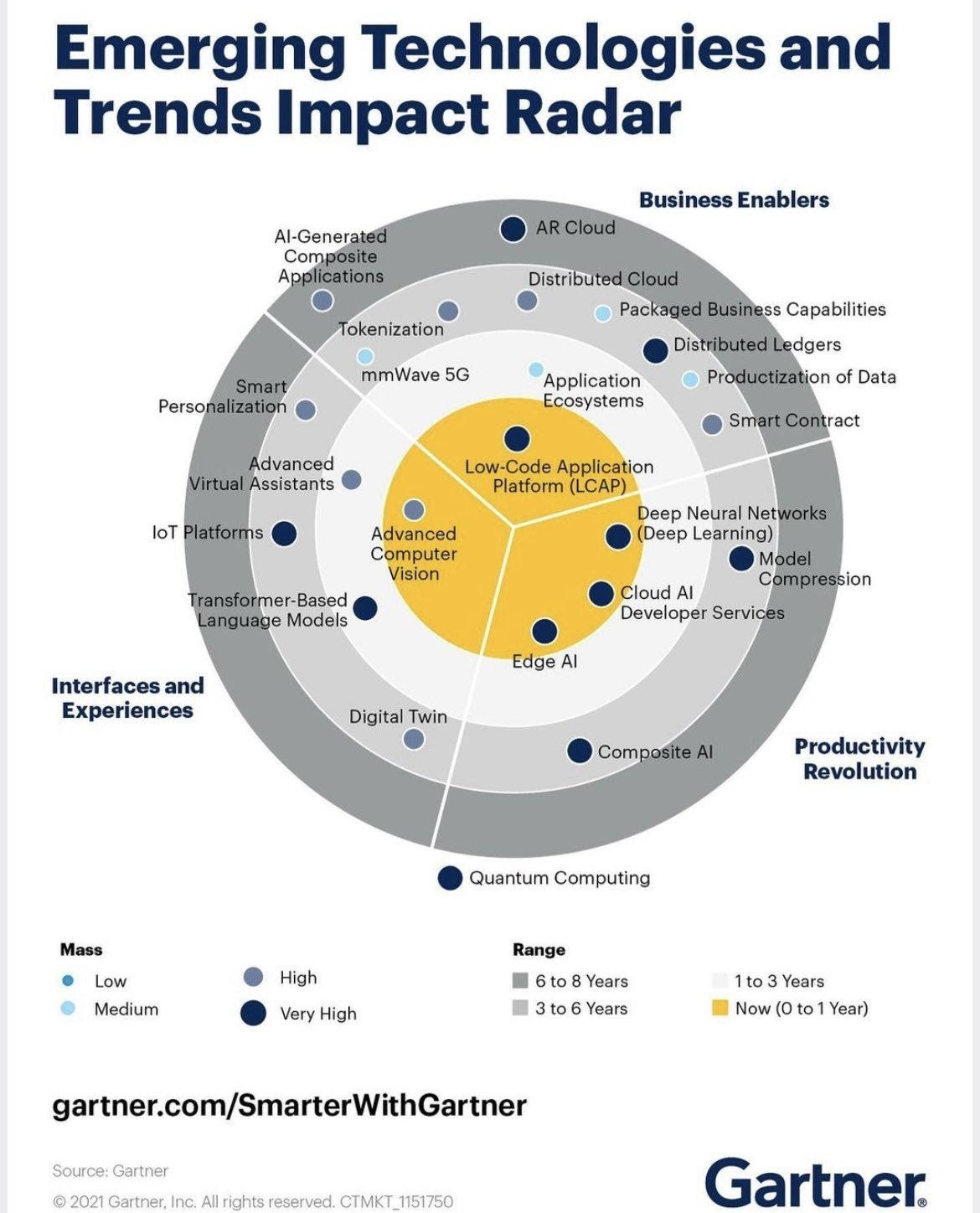
According to Gartner's Trend Impact Radar, Low-Code Application Platforms (LCAPs) are positioned near the epicenter of transformative technologies within the IT landscape. This strategic placement underscores the paramount importance and wide-reaching impact of LCAPs, situating them at the heart of innovation alongside groundbreaking technologies such as Deep Neural Networks (Deep Learning), Cloud AI Developer Services, Edge AI, and Advanced Computer Vision.
The central positioning of LCAPs on the radar is not just a testament to their current significance; it signals a robust, ongoing trajectory of influence that is expected to persist and expand. This prominence reflects the growing recognition of LCAPs as pivotal enablers of agility, efficiency, and democratization in application development. By simplifying the development process and making it accessible to a broader range of professionals, LCAPs are breaking down traditional barriers to innovation and accelerating the pace at which businesses can respond to changing market demands and technological advancements.
A Guide to Principles and Best Practices for Low Code Development
Low code development transforms traditional software creation through automation and simplified design, yet it necessitates a strategic approach for optimal outcomes. Achieving the best results from low-code initiatives hinges on a blend of sound business acumen and technological insight. Here are key principles to guide successful low-code development projects:
Comprehensive Platform Understanding
Strategic Engagement with Low-Code Platforms: Mastery of the chosen low-code platform is crucial. It's imperative for all involved parties—from developers and business analysts to project managers—to actively engage in the platform's selection and utilization. A deep dive into understanding the platform's features and potential will equip the team to leverage low-code solutions effectively, thereby enhancing future projects and maximizing the return on investment.
Minimize Customization
The essence of low-code efficiency lies in its library of pre-built components designed for drag-and-drop integration into applications. While these components are versatile, over-customizing to fit specific programming tasks can erode the advantages of low-code, such as its speed and cost-effectiveness. It's advisable to use these generic components wherever possible to maintain the platform's inherent efficiency.
Smart Customization
When customization is necessary, aim for generality. Design customized components with broad applicability in mind, allowing for their reuse across multiple projects. This approach not only streamlines development within the current project but also builds a repository of assets that can accelerate future initiatives.
Team Dynamics and Collaboration
The selection and application of a low-code platform require a team that is well-versed in both the project's technical requirements and its business objectives. Even in a simplified, low-code environment, a nuanced understanding of project goals remains essential. Continuous collaboration among product owners, stakeholders, and the development team is vital to ensure the project stays aligned with business needs.
Business-Driven Development
The agility of low-code platforms enables rapid iteration and experimentation. However, maintaining a clear project plan and roadmap is essential to keep development efforts focused and aligned with strategic goals. Regular testing, stakeholder engagement, and iterative reviews are critical to adapt to changing requirements and ensure the project delivers value aligned with business objectives.
In summary, while low-code development offers a path to faster and more accessible software creation, its success is deeply rooted in strategic planning, understanding of the platform, judicious use of customization, and strong collaboration between business and technical teams. By adhering to these principles, organizations can fully harness the power of low code to drive innovation and achieve their digital transformation goals.
Key Capabilities for Enterprise Low Code Applications Platform
The cornerstone of Low Code No Code (LCNC) development is its reliance on visual drag-and-drop design capabilities, which replace the need for understanding the complex syntax associated with traditional programming languages. This approach significantly lowers the barrier to entry for app development, making it accessible to a broader range of users, from professional developers to business analysts.
Visual Business Logic and Decision Rules
LCNC platforms provide visual tools to define and automate tasks, operations, data manipulations, conditional logic (if-else statements), and loops. Visual programming provides users with the ability to represent complex business logic through simple, diagrammatic representations. It is excellent for translating business logic into operational applications.
Rapid Prototyping and Testing
A pivotal advantage of LCNC development is the ability to prototype applications quickly and iteratively test them within the development environment, allowing developers to receive immediate feedback enabling them to refine and adjust applications on the fly, significantly reducing the time from concept to deployment.
Business Workflow Mapping
Effective LCNC platforms offer sophisticated tools to diagrammatically represent and automate complex business processes involving multiple stakeholders and steps. Using these methods for organizational benefits streamlines operations, allowing for visual mapping and optimization of workflows. This ensures that business practices accurately reflect and enhance actual practices.
Enhancing Development Efficiency: Integrating SDLC, CI/CD, and DevOps
Advanced Low Code No Code (LCNC) platforms stand out for their comprehensive support of the software development lifecycle (SDLC), Continuous Integration/Continuous Deployment (CI/CD), and DevOps practices.
These platforms go beyond simplifying application development; they embed into the broader ecosystem of development tools and methodologies, ensuring that applications developed on these platforms can be managed, integrated, and deployed as efficiently as traditional code-based applications.
Comprehensive SDLC Support: Look for platforms that offer tools and integrations supporting the various phases of the software development lifecycle, from initial design to deployment.
Environment Segregation: Platforms should provide separate instances for development, testing, and production environments. This segregation is critical for maintaining the integrity of the production environment and ensuring that new changes are thoroughly vetted before deployment.
CI/CD Integration: Whether through built-in capabilities or seamless integration with industry-standard CI/CD tools, support for continuous integration and delivery is essential for automating the deployment process and ensuring a smooth, efficient release cycle.
Continuous Platform Evolution: A hallmark of leading LCNC providers is their commitment to the ongoing enhancement of their platforms. This includes regular updates, the addition of new and necessary functionalities, software components, and templates. Such continuous improvement ensures that developers have access to the latest tools and capabilities, enabling them to build state-of-the-art applications that meet current market demands.
Optimizing Data Integration
In the digital age, the ability to seamlessly integrate with a variety of corporate data repositories—such as ERP (Enterprise Resource Planning), CRM (Customer Relationship Management), HR systems, or document repositories—is indispensable for developing applications that drive business value. Traditionally, creating these integrations has demanded extensive technical efforts, deep knowledge of the specific data systems involved, and significant development resources. As you consider a Low Code No Code (LCNC) platform for your development needs, focus on these critical aspects related to data connectors:
Pre-built Data Connectors
Comprehensive Integration Options: Opt for a platform equipped with an extensive array of pre-built data connectors. These connectors should offer direct, out-of-the-box access to the most common data repositories used within your organization. The availability of such connectors significantly reduces the complexity and time required to establish data integrations, accelerating the development process and ensuring that your applications can readily utilize essential business data.
Custom Connector Development
Flexibility in Connector Customization: Assess the platform's capabilities regarding the creation and publication of new data connectors. An ideal LCNC platform not only facilitates the rapid development of custom connectors but also supports their easy publication for reuse across the organization. This flexibility is vital for extending the platform's utility to encompass specialized or unique data sources, thereby enhancing the overall adaptability and effectiveness of your applications.