

What are the Key Challenges to Starting a Lending Business?
What is a Loan Origination System Tailored to Student Loans
How Loan Origination Can Be a Game-Changer for Trade Schools
Streamlining Financial Aid Processes
Meeting Expectations of Digital Natives
Offering Customized Payment Plans
Invoicing for Multiple Expenses:
Accelerating Loan Approvals with Sophisticated Credit Analysis
Benefits of Automation in Enrollment Processes
Implementation of Automation in Enrollment Processes
Process Mapping and Assessing Current Business Practices
Choosing the Right Automation Tool
The private student financing sector has witnessed an impressive annual growth rate of approximately 7% over the last five years.This growth signals a thriving environment for innovation in the education sector, where institutions increasingly invest in native lending solutions. These advanced offerings are being woven into loan packages and products to remove barriers to student admissions. As we navigate and influence the future trends in student lending, the sector is poised for significant transformation, promising to enhance the accessibility and flexibility of education financing for upcoming generations. In this article, we delve into how streamlining financial aid processes through the use of loan origination software significantly enhances the accessibility of educational financing, particularly for trade school programs.
What is a Loan Origination System Tailored to Student Loans
Loan Origination Systems (LOS) tailored to student loans are specialized software solutions designed to streamline and manage the process of originating student loans, from application to disbursement. These systems are specifically developed to address the unique requirements of student financing, incorporating features and functionalities that cater to both lenders and borrowers within the education sector. Loan origination software can play a pivotal role in helping trade schools enroll more students by addressing some of the fundamental barriers to education access, primarily financial constraints.
How Loan Origination Can Be a Game-Changer for Trade Schools
Streamlining Financial Aid Processes
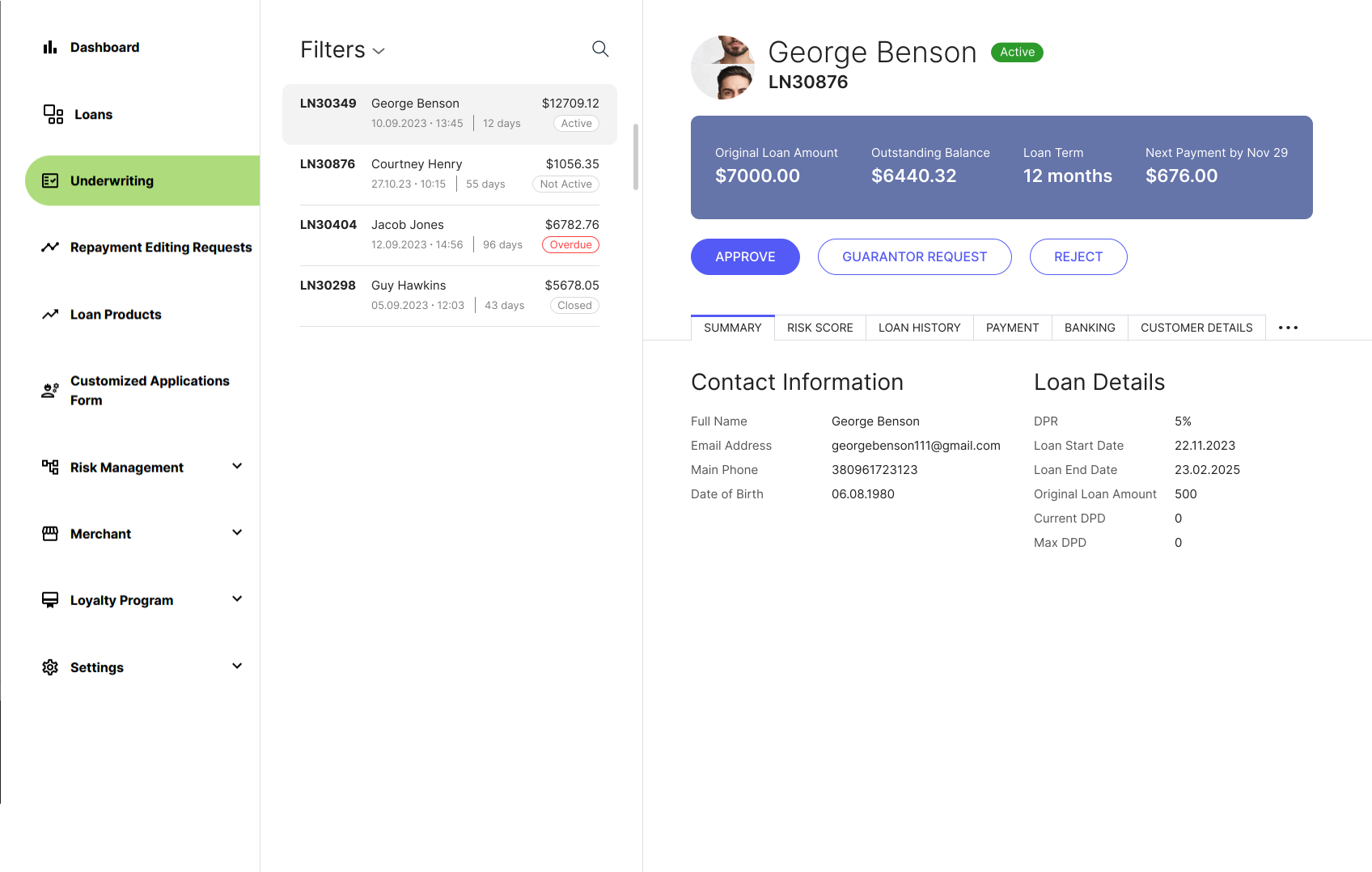
The Automated Financial Aid Application is a game-changer in the enrollment process for specialized courses, addressing the inefficiencies and inaccuracies inherent in manual procedures. Traditional methods, characterized by extensive paperwork, manual data entry, and cumbersome tracking, are not only time-consuming but also prone to errors, creating a bottleneck in the financial aid application process. Automation revolutionizes this scenario.
By employing student financing software, the financial aid application process is transformed from a daunting task into a streamlined, user-friendly experience. This innovation allows students to apply for their chosen courses with unprecedented ease, eliminating the need for physical visits to the institution or enduring lengthy waits. The convenience of applying from anywhere at any time not only saves valuable time but significantly enhances the student experience, making education more accessible. Our loan application system provides a multi-channel approach—online, in-branch, and via call centers—to accommodate different student preferences, enabling loan applications through the most convenient method for each individual. It features seamless integration for scanning and automatically categorizing key information from documents such as identity proofs, degrees, and certificates, streamlining the onboarding process.
This streamlined approach is especially beneficial for trade schools, as it directly addresses one of the major barriers to student enrollment: the complexity and time investment required by traditional financial aid applications. By simplifying this process, trade schools open their doors to a broader demographic of students, including those who may have previously been deterred by the anticipated hassle and time commitment. The automation of financial aid applications thus serves as a powerful tool in expanding access to education, attracting a wider pool of applicants, and ultimately, enriching the student body with diverse talents and aspirations.
Meeting Expectations of Digital Natives
Generations Y and Z have grown up with the internet and smartphones, making them more inclined towards digital solutions for their needs. They expect processes to be fast, efficient, and available 24/7. Gen Z students, accustomed to the immediacy of online shopping, streaming services, and social media, would find digital enrollment platforms more intuitive and aligned with their daily habits. An automated enrollment system that allows them to browse courses, submit applications, and receive instant confirmations online caters directly to these expectations, contrasting sharply with the traditional, manual enrollment methods that would likely deter them.
Offering Customized Payment Plans
By integrating specific settings within the loan origination software, educational institutions can proactively enable students to devise a payment strategy that aligns closely with their individual financial conditions. This approach significantly personalizes the financial planning process, ensuring that each student's unique needs are met with precision.
An illustrative example of this flexibility is the implementation of payment plans, a distinctive offering from some schools aimed at easing the financial burden on students. These plans vary from one institution to another but share a common goal: to provide a manageable alternative to lump-sum payments.
For example, consider a scenario where a school offers a payment plan enabling a student to distribute the cost of tuition over several months. Instead of requiring a single payment of $4,200 for a 6-month program, the plan could allow the student to pay in monthly installments of $700. This structure not only makes education more accessible by fitting into the student's monthly budget but also reflects the school's commitment to accommodating diverse financial situations, ensuring that financial constraints do not hinder educational advancement.
Invoicing for Multiple Expenses:
The loan origination system extends its utility beyond mere loan management by enabling educational institutions to issue comprehensive invoices that cover a broad spectrum of student expenses. This functionality is crucial for streamlining financial operations, as it consolidates billing for various costs such as tuition fees, textbooks, accommodation, laboratory fees, and other educational materials into a single, unified platform.
By aggregating all charges into one accessible location, the system simplifies the financial management process for both the institution and its students. Students benefit from a clear, itemized overview of their financial obligations, which aids in budgeting and financial planning. Meanwhile, educational institutions enjoy the efficiency of managing financial transactions through a centralized system, reducing administrative workload and minimizing the risk of billing errors.
This integrated invoicing capability fosters a more transparent and organized financial relationship between students and institutions. It ensures that every charge is accounted for and easily trackable, facilitating timely payments and financial clarity. Moreover, by accommodating a wide array of expenses, the system reflects the comprehensive financial needs of students, addressing everything from their academic costs to their living expenses, thereby enhancing the overall educational experience.
Accelerating Loan Approvals with Sophisticated Credit Analysis
Sophisticated loan origination systems, equipped with advanced credit decisioning capabilities, represent a transformative advancement in how educational institutions manage and process student loan applications.
Quick Loan Approvals: The cornerstone of a streamlined loan origination process is the ability to rapidly assess an applicant's creditworthiness through advanced credit decisioning. This process is driven by sophisticated algorithms that meticulously analyze various dimensions of an applicant's financial profile, including but not limited to credit scores, payment history, existing debts, and income stability. By integrating these complex evaluations, the loan origination system can swiftly determine the eligibility of applicants based on predefined criteria tailored to the educational sector's unique requirements.
Decision Logic: The system employs a robust decision logic framework to automate the approval process. When an application surpasses the established creditworthiness threshold, it triggers an automatic approval mechanism. This threshold is meticulously defined by the educational institution and is a reflection of its risk tolerance and financing strategy. For applications that hover near the threshold, the system may issue a conditional approval, prompting further actions such as additional documentation or interviews to fully assess the applicant's suitability.
Manual Review Escalation: Recognizing the limitations of automated systems, the loan origination software includes a protocol for escalating applications that either do not meet the automated underwriting criteria or are marked for potential discrepancies. This manual review process is a critical safeguard, ensuring that all applicants are given fair consideration. By incorporating human judgment into the decision-making process, institutions can address any anomalies, exceptional cases, or errors in the application, thereby maintaining the integrity and inclusiveness of the student financing process.
The multi-layered approach to credit decisioning—combining automated efficiency with the nuance of human oversight—ensures a balanced, fair, and expedient loan approval process. By tailoring this, system to the specific needs of the education sector, trade schools can offer more accessible and appealing financing options, thereby removing financial barriers and fostering greater educational opportunities.