
What is a Loan Origination System and How it Helps Borrowers and Lenders

Loan origination practices are rapidly evolving from manual tasks ,paperwork. and face-to-face meetings between applicants and lenders to digital online self-service. This evolution is making it easier and faster for borrowers to get loans and much easier for lending institutions to perform all loan-related tasks. AI-powered digital loan origination systems like CompassWay play a key role here, making the loan origination process more joyful, comfortable, and profitable for both applicants and financial institutions.
What is the Loan Origination Process?
The workflow of loan issuance is quite complex. The loan origination lifecycle covers all the steps involved in lending – from the borrower’s application to the transfer of money to the borrower and repayment of the loan. It also includes processing applications, evaluating the applicant’s creditworthiness, making a decision, underwriting, and granting the loan (or rejecting the application). When it comes to mortgages, the evaluation of the borrower’s property is also an important step. In the pre-digital reality, the loan origination process flow was time-consuming, involved a lot of human resources, and was inconvenient and sometimes stressful and risky. Now, due to digital systems, it’s becoming more user-friendly, quick, simple, and safe.
Now, let’s answer the question: which of the following is completed first in the loan origination process?
- borrower assessment
- disbursal of funds
- underwriting
- application
- credit repayment
Submitting an application? The answer is not so obvious. As this loan origination process flow diagram shows, the pre-qualification process comes first.

The mortgage loan origination process flow diagram slightly differs and includes the property assessment stage. Now let’s take a look at some important points related to the loan process
Two types of Application Process
The application process can be divided into two broad groups: branch-based and online self-service. Many organizations still use the first option, while innovative companies using advanced digital technologies have moved to the second one.
Branch-based
A branch-based (or agent-assisted) loan application is made through face-to-face interactions between a borrower and an officer of a credit organization, which requires visiting a ‘brick and mortar’ office. In this case, the client usually meets with a sales agent who helps him complete the form, choose suitable loan plans (e.g. terms and rates), gather the necessary documentation, consider additional products (for example, payment insurance), and finally sign the document. The application can be filled out on a paper form or through an online application on the device of an employee of the organization. In any case, the most important thing at this stage of the application is to accurately record the client’s details. This outdated type of application consumes a lot of time and effort of the credit organizations’ staff. It is also inconvenient for clients.
Self-service Application
Digital loan applications for self-service can happen in many different ways, and the process has evolved over time. At first, printing and faxing applications were required. Then, many institutions moved to online form completion, but again, the form had to be printed and sent to the lending organization’s office. Finally, financial institutions began to practice filling out forms online on a website without the need to print fax, or mail. However, this method still had many disadvantages, including inefficiency and overly time-consuming loan origination workflow, as well as a lot of extra work. By the way, some organizations still offer the above methods to their clients.
Innovative Application Process
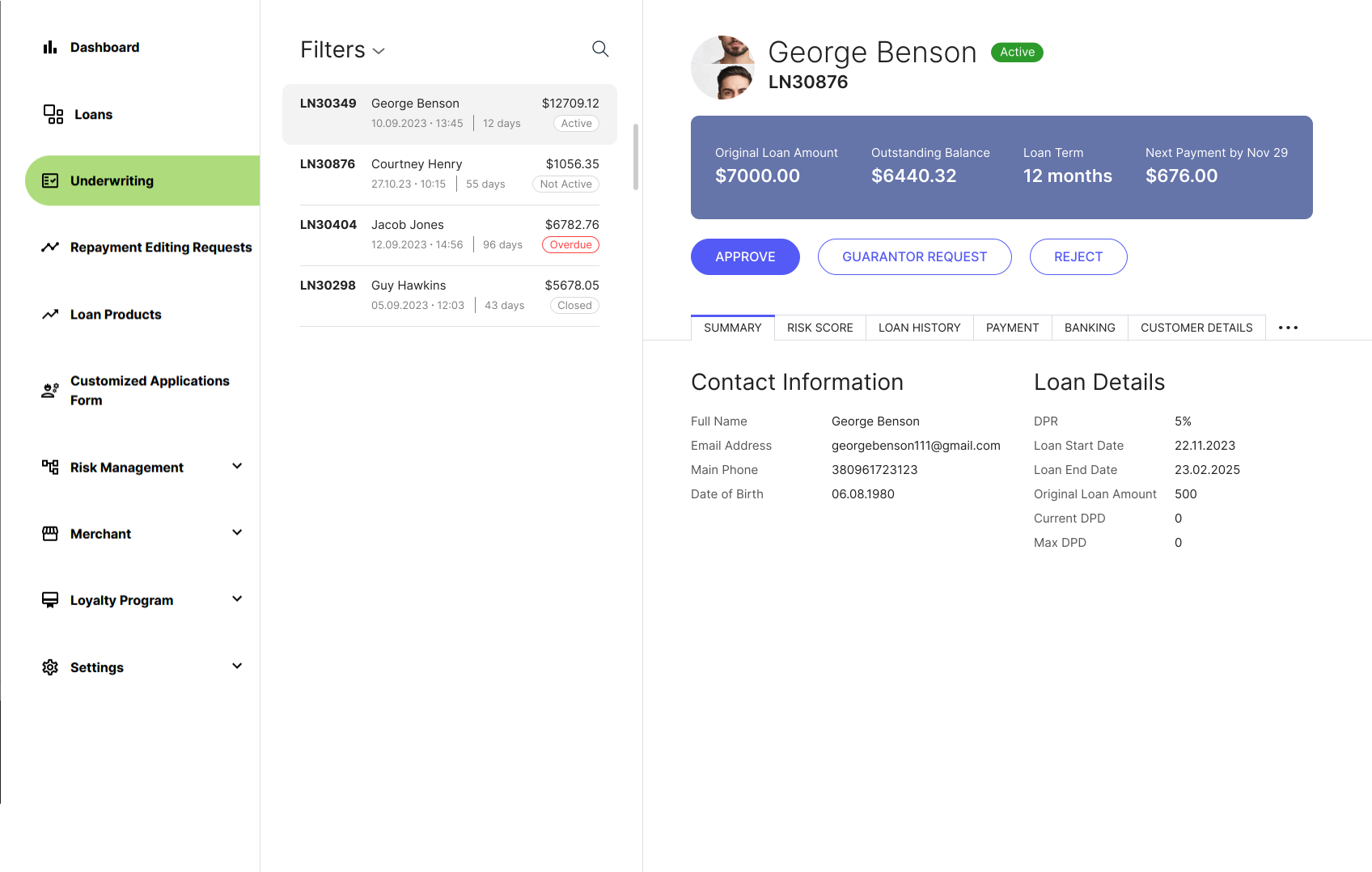
Modern loan application processing systems such as CompassWay have made the application process much faster and easier. These systems offer an intuitive interface for both borrowers and finance institution’s managers. They also have the following important features.
- Modern loan origination software does not ask unnecessary questions, focusing only on those that are really important for each particular loan.
- The system automatically fills in the already existing data if the borrower is already a client of the company.
- The advanced loan origination system makes the process faster and more borrower-friendly, so applicants are not rejected as often, and the customer base grows faster. According to The Digital Banking Report, the slower the application process, the more borrowers are unfairly rejected.
- Modern AI-enabled software is able to quickly pre-qualify the application and the borrower, automatically make a decision based on a large amount of data, and provide a quick response to the customer.
All of the above features make the application process much faster and more convenient for both borrowers and credit company officers.
Here is an example of the application process in a loan origination system with instructions.
Key Aspects of Loan Processing
Applicant Assessment and Decision Making
These are the key steps in the loan origination process flow. After the application is submitted, the next loan origination process steps include processing the loan and deciding whether to grant а credit or reject the application. At this stage, it is important to assess the creditworthiness of the borrower by considering many factors: credit history, income, employment details, and many others. If the borrower has debts, one of the criteria for loan approval is the so-called debt-to-income ratio” (DTI). If an applicant has too much debt to repay and that debt goes over the DTI limit, the borrower will either have to repay debts at a later date or repay only the remaining debt. When the applicant refinances his credit, he can pay off the outstanding debt. Based on all the important information about the borrower, a decision is made to grant or deny the loan. Looking ahead, in modern loan disbursement systems, such a decision is generated automatically.
Pricing
There are three traditional pricing practices for borrowers: 1) equal interest for all, 2) risk-based pricing, and 3) relationship-based pricing. Let’s briefly consider each of these.
All borrowers have the same rate. This is a somewhat outdated and not very efficient approach. Most lending companies have removed it from their loan origination process flow. In this pricing model, high-quality and promising customers pay an above-market rate. At the same time, high-risk borrowers receive a more favorable rate than they would otherwise receive, resulting in a lower rate of return on the credit to the financial institution than the risk would suggest.
Risk-based rates. Under this approach, rates depend on various risk-associated factors, including credit score, loan maturity (expected duration), etc.
Relationship-influenced pricing. This approach is used to offer a more favorable rate to clients who have a significant business relationship with a credit organization. It is often offered in addition to the regular rate. This is a more flexible approach that increases customer loyalty. It is usually the latter two types of pricing that are used in digital loan origination systems.
Document Preparation and Underwriting
Document preparation is the procedure that involves organizing and preparing the applicant’s closing agreement. These documents differ from industry to industry but typically include a memo, disclosure, and other related documents that outline and detail the agreement between the client and financial institution. An underwriter is an employee who assesses credit docs and decides whether the credit complies with the rules of a particular loan program. The underwriter’s tasks include evaluating the risk level of the loan and making a conclusion on whether to grant or deny the credit. In cutting-edge systems, these two tasks are performed fast, accurately, and with minimal human involvement.
Finally, the disbursement of the loan takes place and the borrower gets his money. In general, the 4 stages of the loan origination process include the following main steps: borrower assessment, decision-making, underwriting, and disbursement.
Automation of the Loan Cycle
Loan origination systems like CompassWay are able to automate almost all of the lending tasks, helping companies grow their customer base faster while reducing risk, cutting costs, and improving digital loan experience for borrowers. Not surprisingly, more and more credit organizations are using such systems to gain a competitive advantage and increase their profits. At the same time, many financial institutions continue to use outdated methods. At the moment, there is an ever-widening gap between companies that choose innovative digital loan origination and experience growth and those that stick to tradition and risk permanently losing their position in the lending market.
The automated loan origination system process covers the entire loan workflow, including borrower assessment, loan processing, decision-making, real-time compliance checks, underwriting, disbursement of funds, tracking loan status, and monitoring timely repayment. All these tasks are performed automatically.
The system collects all necessary data about the client, including information that is not available in traditional loan processing (e.g., social media activity, frequency of change of residence, etc.). After evaluating the applicant based on all the necessary data, the system generates an automatic loan decision and determines the recommended loan amount and interest rate. Then, if the decision is positive, automatic underwriting and disbursement of funds takes place.
Automation of the digital lending process saves employees of financial institutions from a large amount of manual labor and human error, helps avoid risks, and significantly speeds up the performance of all tasks. At the same time, automation increases the accuracy of data processing, facilitates successful loan decisions, and improves customer experience. Applicants can easily take any type of loan, be it a delight loan or a mortgage loan. The entire process is flexible and smooth. Better quality customers get better terms and conditions, which increases their loyalty. With digital loan processing, the speed of loan disbursement has increased manifoldly. In some cases, it takes minutes from application to disbursement. The loan origination date may often coincide with the date of application. What is the loan origination date? This is the day on which the borrower receives the money.
This loan origination system workflow diagram looks simpler and slightly different from the diagram illustrating the traditional approach above. Since all procedures take place online, the initial step here is the submission of the application, which triggers the whole further chain of automated events.

Credit organizations should definitely automate their loan origination flow to become a powerful player in the digital lending landscape. Fortunately, the market offers enough high-tech solutions for this. The list of loan origination systems is rather large now. However, when choosing an automated digital platform, make sure it offers the following benefits. The best loan origination software should provide all of them.
Benefits of Loan Origination Systems
- Customization capabilities. Advanced systems allow for flexible customization to meet the needs and specifics of a particular company. In this way, you can customize workflow and decision-making rules, configure administrative features, and ensure full compliance with organizational policies.
- Scalability. The system must be scalable, allowing for both scaling up and scaling down without sacrificing quality or speed. This is especially important for organizations looking to grow and expand, increase their customer base, and expand their product portfolio.
- Compliance. Among other things, loan origination systems assist credit companies in compliance with organizational rules and other regulations.
- Data Collection. This is a critical stage in digital loan processing. Automated loan origination systems considerably speed up borrower data collection, make this process more accurate, ensure data completeness, and eliminate any errors, duplicated information, and any kind of inconsistency. Such quality and speed of data collection is not possible without the use of advanced software, even if a highly professional team is involved in the process.
- Creditworthiness assessment. Good loan soft automatically performs credit checks, detects fraud risks, and carries out other analyses based on the comparison of a large amount of data to establish the creditworthiness of the borrower.
- Decision making. The automated system also takes care of the decision on loan disbursement. It assists lenders in processing data to make a successful credit decision, reduces decision time, and results in more precise decision-making.
- Speed. Advanced lending software provides an unprecedented speed of loan origination process. It swiftly evaluates borrowers and automatically generates the credit offer with relevant terms and interest rates.
As a result, loan origination systems reduce overhead costs, mitigate risks of all kinds, provide a significant competitive advantage, and contribute to revenue growth.
The best way to ensure that your system will provide you with all of the above benefits is to book a demo. It will give you a comprehensive and clear understanding of how our loan origination platform will help your business grow and prosper.
About Compassway
CompassWay is an all-in-one lending platform that automates the loan origination process from application to funding, delivering a best-in-class experience for your clients and team – for any loan product. With advanced algorithms and analytics, small lenders can quickly score clients and automatically make credit decisions. By reducing time and costs during the origination and loan portfolio management stages, financial institutions become more productive and have more room to develop new businesses.
Navigation: