

How to Streamline Underwriting for Faster and Error-Free Loan Approval
The high speed of loan disbursement is one of the undoubted competitive advantages in the modern lending world. More and more borrowers expect their applications to be processed promptly, choosing those financial institutions that are able to provide them with such service. But how can you increase the pace of application approval without exposing yourself to the risk of incurring losses due to hasty decisions? In this sense, automated underwriting systems like CompassWay are a true game-changer that significantly expedites the entire lending process without compromising on accuracy and security. It marks a fundamental shift in the way loans are issued and defines a new era of speed and at the same time precision.
Many conservative financial institutions still use the traditional approach to underwriting. It is performed manually by a team of human underwriters, involves a lot of paperwork, and is fraught with human bias and errors. In addition, it is very time-consuming, as it is not an easy task to adequately and comprehensively evaluate borrowers’ applications, especially when there are many of them. As a result, applicants have to wait for a loan decision for a long time, often receiving a rejection.
The fact is that with manual underwriting, the level of refusal to grant a loan is quite high. With the mass evaluation of multiple applications, a person or even a team of people does not have the opportunity to dive into each case to study the unique financial situation of each borrower. Therefore, formulaic and very cautious decisions are made. If any of the applicant’s criteria do not meet the lending policy, they will likely be denied regardless of their actual creditworthiness. As we will see below, automated systems are much more flexible in this sense.
Challenges of traditional underwriting
Traditional manual underwriting has consistently faced a number of issues. They have become particularly apparent now with automated systems utilizing AI and machine learning at underwriters’ service.
Lengthy process
Underwriting is a key stage of lending. Underwriters take on a great deal of responsibility on a daily basis, assessing all the risks associated with each application. They have to take into account a host of details such as the applicant’s employment, income, credit history, assets, and so on. All of this needs to be collated, and verified to make a judgment about the creditworthiness of each potential customer, which then directly affects the approval of the application and the disbursement of funds. Mistakes here can be costly. It is unacceptable both to approve the application of an unreliable borrower and to refuse a promising client. That is, in fact, the welfare of the credit organization depends on the work of underwriters. It is not surprising that such a responsible process takes quite a lot of time. In a traditional underwriting system decisions could be made within days and weeks. And there was nothing that could be done about it … until the advent of automated underwriting systems.
Poor data quality
When applicant data is collected, entered, and verified by humans, all sorts of mistakes, inconsistencies, and white spots are inevitable. As a result, the borrower’s risk profile may appear incomplete or even erroneous. Underwriters had to use numerous manually filled Excel spreadsheets where confusion often occurred. At best, inaccuracies were detected and corrected, which again took additional time. At worst, they went unnoticed.
Inaccurate loan decisions
The quality of data directly affects the quality of decisions that are made based on available information. Therefore, any kind of faults, inconsistencies, poorly verified, and incomplete information result in insufficiently accurate credit decisions. In addition, no matter how highly professional an underwriter is, nothing human is alien to him. He or she is not immune to excessive subjectivity and bias, which can hinder adequate decision-making. Finally, given the large amount of data to be taken into account, underwriters are not always able to clearly understand and assess the true paying capacity of each borrower.
Limitations in expanding the customer base
Inaccurate and not always adequate credit decisions in turn prevented the effective growth of a quality customer base. It often happened that creditworthy customers could be rejected, while doubtful and unreliable ones could get a loan. Again, until automated underwriting software came along, this was inevitable, because there are too many factors and variables that matter in such a complex process as risk assessment. In addition, the expanding customer base required additional human resources and therefore additional costs to process the increased number of applications.
Compliance challenges
Compliance is essential to the successful and safe operation of a credit institution. Such compliance can be of two types: with the norms and laws of a particular state, as well as with the policies of the organization itself. First, both may be constantly changing and being adjusted. Secondly, their interpretation could also be subjective and not always correct. Thus, ensuring compliance with all rules and regulations has always been a serious headache for employees of financial institutions.
Poor customer experience
With traditional underwriting, both the application mechanism and the process of its evaluation and approval are considerably more complicated and time-consuming. To qualify for a loan, a borrower often had to visit the physical office of a financial organization, bring documents, write and sign an application, and talk to a company representative. However, the fact that this procedure could be different and much simpler became known only with the emergence of advanced loan management systems with automatic underwriting functionality.
What is automated underwriting
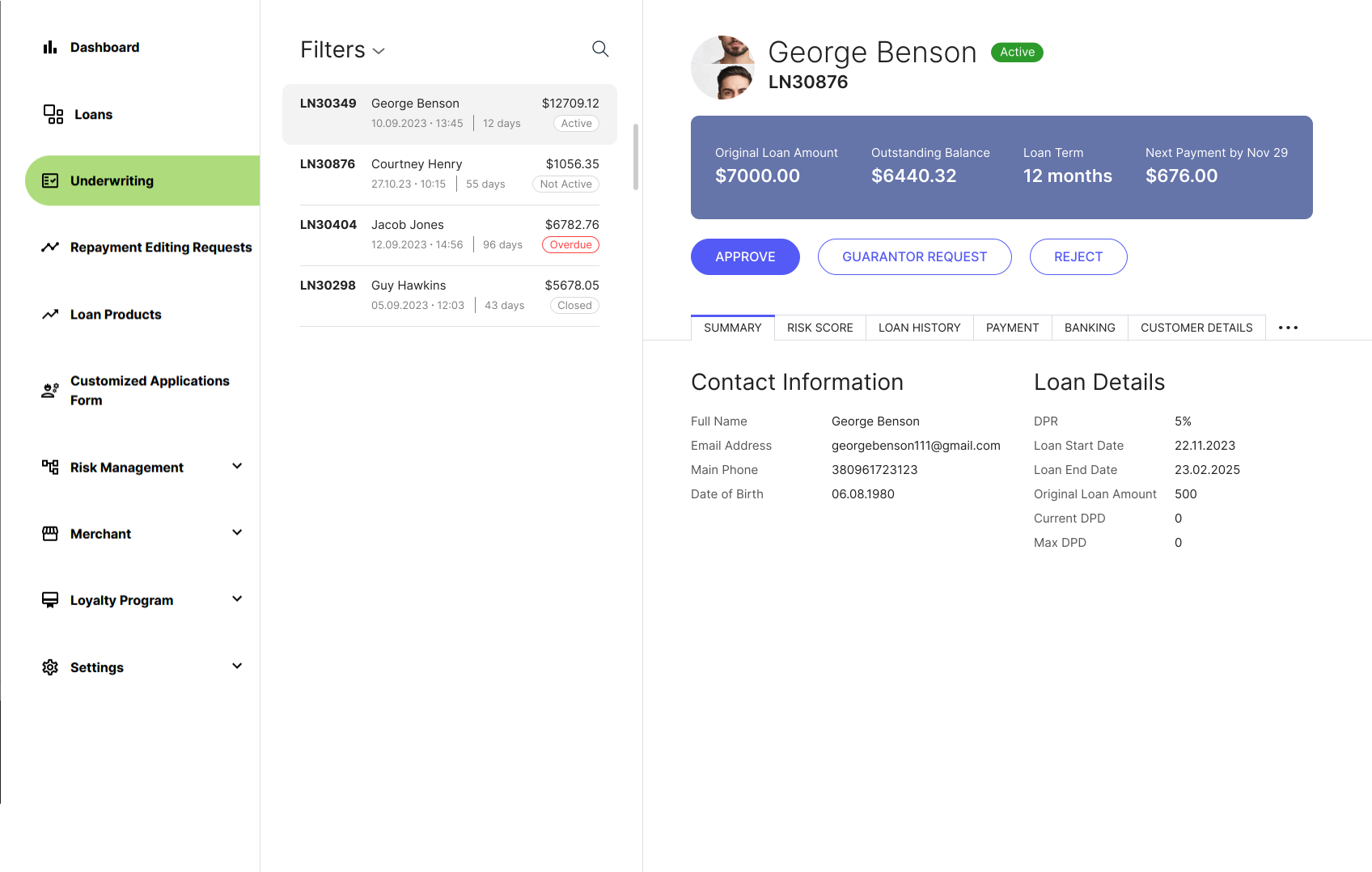
An automated underwriting system (AUS) is software that handles virtually all the processes involved in accepting, evaluating, and approving applications. Using deep data analysis and advanced AI algorithms, such systems significantly speed up, simplify, and enhance the quality of the loan process. How does it work?
All necessary data is provided by the borrower online, without the need for personal interaction with employees of the lending organization. As soon as the information enters the system, it immediately begins to study the data, checking it for possible errors, inconsistencies, incompleteness, etc. If it finds any deficiencies, it signals it. In some cases, it requests additional information to get a more comprehensive view of the borrower’s creditworthiness.
Next, the automated underwriting system analyzes all available data and correlates it with preset rules. Based on the analysis, a decision or rather recommendation for decision-making is automatically made: approve the application, reject the borrower, request additional information, or redirect for manual underwriting. All of this happens almost instantly, saving the lending team from laborious, time-consuming work.
However, loan automation does not mean that the system’s conclusions are rigidly deterministic and inflexible. On the contrary, through the use of machine learning, the software learns to recognize complex regularities and trends in a borrower’s paying behavior. It is able to capture hidden nuanced patterns that may escape the attention of even experienced underwriters. Thus, the applicant’s risk profile turns out to be as detailed as possible, and the system’s decisions are always accurate and well-grounded. Intelligent predictive analytics allows us to forecast quite precisely the performance of a particular loan and also helps to set the most optimal loan terms: interest rate, repayment period, down payments, closing costs, etc.
Let’s take a closer look at the processes involved in automatic underwriting.

Data collection
Collecting and organizing applicant data is where automated underwriting begins. Basic information is provided by the borrower. It may include:
- Personal information
- Income
- Credit reports
- Public records
- Savings and assets
- Financial records
- Employment history
To get a clearer picture of each potential client’s case, the system may request extra information such as pay stubs, rent receipts, bank statements, tax returns, etc.
Data verification
Utilizing advanced document processing functionality, AUS helps verify the accuracy of all the information provided by borrowers. It effectively detects any mismatches, bugs, and incomplete entries and immediately alerts you to them. This significantly improves the quality of data, and therefore the quality of loan decisions.
Risk assessment
Through machine learning algorithms using statistical models and a large amount of historical data, the system builds a nuanced risk profile of each applicant. It automatically identifies borrowers’ key indicators such as credit scores and debt-to-income ratios, as well as additional factors like employment stability. These indicators serve as the basis for the system’s recommendations for each application.
Preset rules
Systems for automatic underwriting use customizable rules that reflect both the regulations of a country and the internal policies of a particular organization. For example, a credit institution may establish a minimum credit score for automated mortgage processing.These rules can be easily replaced and adjusted and then automatically applied to each loan. This provides the system with flexibility and the ability to adapt to ever-changing norms.
Decision Making
After processing the data, assessing the risk, and applying predefined rules, the system generates recommendations for further decision-making. Recommendations can be of several types:
- Approve. When the borrower meets all requirements for a loan and the associated risk factors are acceptable to the organization, the system recommends approval of the application.
- Deny. AUS recommends denial of a loan if the applicant clearly does not meet important criteria or if the risks associated with the borrower exceed a threshold of acceptability.
- Referral. Occasionally, a human underwriter is still required to review the application. In these cases, the system forwards the documents to a team of analysts who clarify any complexities and additional details for further decision-making. For example, during automated mortgage underwriting it may turn out that the applicant has a high credit score, a good and stable revenue, and a low debt-to-income ratio. But at the same time, according to the credit report, he has a recent bankruptcy. In this case, the system may approve the loan, but with a condition. The applicant will have to explain the reason for the bankruptcy and describe the current situation, providing the relevant documents.
Informing
The system informs the applicant of the decision. If the decision is made automatically, it is communicated almost instantly. In case the application requires clarification, the borrower is notified of further steps and additional documents to be submitted.
Monitoring for compliance
Since the country’s credit laws and the organization’s policies are constantly changing, the automatic loan system continuously monitors rejected applications for compliance. This may result in the applicant’s creditworthiness being reconsidered.
Benefits of automated underwriting
Velocity
One of the most obvious advantages of an automated underwriting platform is the high speed of application processing, which is not possible with manual review. A decision can be made in minutes, while at the same time, it will be reliable enough not to jeopardize financial losses. The system automates and speeds up routine tasks such as data entry and verification, and quickly performs sophisticated analysis to generate recommendations for further decision-making. At the same time, the team can focus on complex cases and place more emphasis on personalized customer service.
Precision in decision-making
Automated underwriting systems significantly reduce the risk of human error, bias, and subjective distortion. Machine learning algorithms, combined with an expanded and high-quality data set, make it possible to precisely predict the risks and rewards of a particular loan. The analysis is strictly based on purely objective criteria and rules, ensuring the accuracy of the decisions made.
Lower interest rates
AUS allows lenders to assess and process more loans much quicker, diminishing the necessity for human input and mistake correction. Thus it significantly reduces the operating costs of an organization. These savings allow for lower interest rates, making them more attractive to a wide range of potential customers.
More clients and higher profits
Automated systems are much more flexible and forward-thinking in their decision-making. They take customer-centricity and personalization to a whole new level. In this way, they make it possible to reach underserved customer segments such as freelancers or small businesses that have great difficulty in obtaining credit with traditional underwriting.
For example, a client with a low credit score and a high debt-to-income ratio, which do not meet the organization’s standards, can get a loan with automated loan decisioning. The system may find that the borrower has a stable income, receipts for timely rent payments, and is willing to make a large down payment.
A freelancer who has not been able to prove the stability of his income and obtain a loan from a traditional institution can expect to be approved for a loan by an automated system. This will happen, for example, if he has a good credit score, a low debt-to-income ratio, and a large amount of savings. Especially if bank statements and tax returns are also in favor of his creditworthiness.
In this way, AUS more accurately determines the underwriting potential of applicants by building more comprehensive and detailed profiles, thus expanding the client base and consequently the organization’s revenue.
Scalability
Even a sharp increase in the client base does not entail a rise in the company’s costs for servicing new customers. The system is able to process large volumes of requests simultaneously without delays or additional expenses and make an automated credit decision within minutes. It doesn’t matter whether an organization receives a dozen or thousands of requests per month, they will all be processed quickly and accurately. This is especially important for companies facing high demand for credits.
Fraud detection
Automated underwriting systems are great not only at verifying and evaluating applicant data but also at detecting fraudulent activity. This functionality is becoming more and more important these days as credit scams continue to increase. AUS is much more effective at detecting suspicious transactions and other potentially dangerous activities than humans.
Streamlined customer experience
With automated underwriting approval, the application and response process is faster, more convenient, and more transparent than ever. Applicants can expect a loan decision to be made very quickly – in many cases, almost instantaneously. This capability along with lower interest rates and flexibility significantly improves the quality of the customer experience and increases the loyalty of existing and potential clients.
Key takeaways
AI-powered automated underwriting systems have greatly transformed the lending landscape, turning loan issuance into a much more productive and accurate process. They enable borrowers’ applications to be accepted, evaluated, and approved with speed and accuracy that were previously unattainable with manual underwriting. In addition, through sophisticated machine learning algorithms and profound data analysis, they help offer customers customized loan products and reach a wider audience. The speed and flexibility provided by automated systems markedly improve customer experience and can significantly reduce costs and increase revenues for lending companies.
About CompassWay
CompassWay is a unified financing platform that automates every step of the loan origination process from pre-qualification to disbursement. It provides an excellent experience for your customers and employees – for any kind of credit product. With intelligent ML algorithms and deep analytics, microlenders can promptly score borrowers and automatically make lending decisions. By reducing time and costs during the origination and loan portfolio management stages, financial institutions become more productive and have more room to develop new businesses.
Navigation: